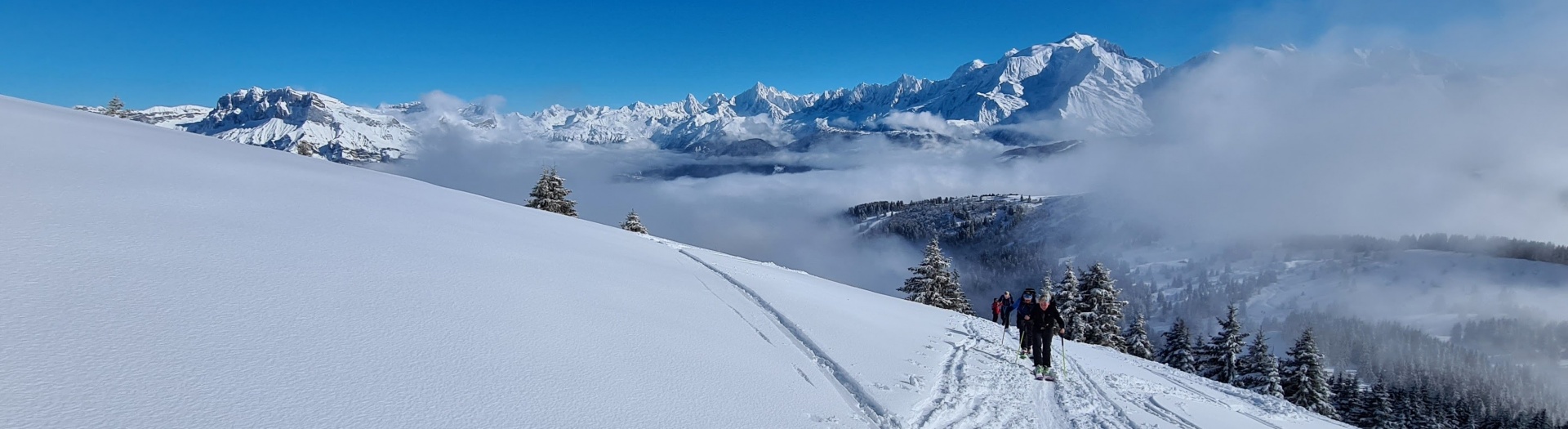

My first ski touring expedition in the Beaufortain
Have you experienced the joys of ski touring and now want to enjoy the freedom of skiing from place to place in a mountain range with gentle slopes and exceptional snow cover?
Join us on this trek from refuge to refuge in the Beaufortain mountain range.
Itinerary
-
Day 1 Arêches - Coire Refuge
 Meet in Albertville early in the morning. Transfer with the guide to Arêches Beaufort (private cars). Equipment rental if necessary, briefing on the weekend's itinerary, and loading of bags with our belongings and food for the evening. We ski up a pretty valley to Lake Saint Guerin. We then discover a wild world surrounded by majestic peaks that promise the best is yet to come...
We reach our unguarded refuge for the night (but comfortable with your places reserved in the dormitory) located at the foot of the Cormet d'Arêche.
We spend the evening independently in this isolated refuge and prepare our comforting meal together around the wood stove before returning to our dormitory for the night.Accommodation: Night in a dormitory in an unmanned refuge.
Elevation gain/loss: +800/- 800m -
Day 2 Refuge de la Coire - Refuge du Presset via the Col du Coin and Col du Bresson
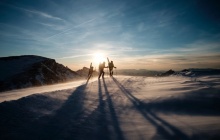 Starting from the Coire refuge, we climb towards the Col du Coin pass through breathtaking landscapes with slopes stretching as far as the eye can see. Once over the pass (2,406 m), you can enjoy some beautiful turns at the foot of the famous Pierra Menta before a final climb to the Col de Bresson pass (2,477 m) and reach the superb Presset refuge where you will spend the night in the warmth.
Accommodation: Night in a dormitory in a guarded refuge.
Elevation gain/loss: +770m/-420m -
Day 3 Presset Refuge - Roseland Lake - Arêches
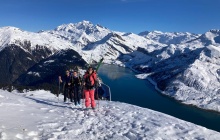 We leave this superb mountain refuge for our last day of hiking with a beautiful descent to Lake Roseland via the Treicol valley before climbing back up to the Charmette pass for a final descent to Arêches, where we finish our trek at the end of the afternoon.
Elevation gain/loss: +400m/-1500m
PROGRAM CHANGES
Dates & prices
Departures for French-speaking groups:
| From | To | Price per person | Guaranteed | Booking |
|---|---|---|---|---|
| €625 | No | Book now! | ||
| €625 | No | Book now! | ||
| €625 | No | Book now! | ||
| €625 | No | Book now! | ||
| €625 | No | Book now! | ||
| €625 | No | Book now! | ||
| €625 | No | Book now! |
International departures:
No departure for now
Trip code: SRBER3J
Included
- Technical organization of the course
- Supervision by a high-mountain guide
- Half-board accommodation in mountain refuges from the evening of day 1 to the morning of day 3
- Picnics
- Technical equipment specific to the circuit
Not included
- Individual ski equipment: boots, skis, skins and crampons, poles
- Safety equipment: avalanche transceiver, shovel, and probe
- Food for the trip (cereal bars, dried fruit, chocolate bars, etc.) as desired
- Ski lifts if there is a change in the program
- Transportation to the starting point of the hike on the first day and from the dispersal point on the last day
- Drinks and personal expenses
Terms and conditions
Booking conditions
Invoice procedure
Cancellation policy
Cancellation on your behalf:
Cancellation on our behalf:
Changes to travel contract
Pricing
Contract transfer
Insurance
Practical info
Staff
This course is supervised by a mountain guide who will provide you with the technical skills you need to enjoy your stay. The guide may modify the program to ensure safety depending on weather and snow conditions in the mountains or the physical condition of participants.
Food
Meals
• Picnic lunch prepared by the guide or eaten in the refuges (please let us know when you register if you have any allergies or specific medical dietary requirements)
• Evening meals in the refuges
• Remember to bring food according to your tastes before departure
Drinks
Personal drinks are not included in the course. Water is available for purchase in the refuges. Bring Micropur-type purification tablets if you do not want to buy bottled water (when water is available, which is not always the case). It is customary in the mountains for clients to pay for the guides' drinks: it is best to set up a kitty for the group at the beginning of the trip, based on each person's means.
Accommodation
In the refuges, dormitories sleep 8 to 10 people and are equipped with blankets or duvets for the night (bring a sleeping bag liner for hygiene reasons). Slippers or Crocs are available in the refuges, so there is no need to bring sneakers. Bring earplugs or similar items to protect against noise pollution.
There are no showers and no running water in the refuges. There are no power outlets, so bring a spare battery for your camera and turn off your phone during the day.
Transportation
Meet at 9 a.m. in Albertville and finish around 4:30 p.m. on the last day.
During the trek, you will carry your belongings for the entire trip: make sure you pack your backpack accordingly so that you are not overloaded but still have everything you need. The guide will check your bags before departure: plan for a 30/40L bag. Remember to leave room for water and a picnic.
Supplied equipment
• Shared equipment (ropes) is provided.
• Slippers are available at the refuge.
• Blankets and duvets are provided at the refuge: remember to bring a sleeping bag liner for hygiene reasons.
Vital equipment
Skis
- 1 pair of touring skis
- 1 pair of touring ski boots (preferably with VIBRAM soles for good grip)
- 1 pair of self-adhesive climbing skins suitable for the skis
- Crampons suitable for the bindings
- Poles with large baskets
Other
- Safety equipment: avalanche transceiver, shovel, probe
- 30/40 liter backpack (preferably with ski straps for ease of use)
- Ski helmet
- Ski goggles
- Survival blanket
- Pocket knife
- Thermos or water bottle
- Towel
- Sleeping bag liner (blankets provided on site)
Material
Head
• Beanie
• Hat or cap
• Scarf and/or neck warmer
• Sunscreen (very high protection factor) and lip balm
• Category 4 glacier sunglasses + ski goggles
Upper body
• 2 long-sleeved technical base layers, such as Carline (no cotton, which dries too slowly)
• 1 technical, breathable base layer
• 1 thick fleece jacket
• 1 down jacket or vest
• 1 windproof and waterproof jacket, such as Goretex
• 1 pair of windstopper mittens (fleece or wool)
• 1 pair of windstopper gloves (fleece or wool)
• 1 pair of undergloves
Lower body
• 1 pair of breathable technical tights, such as Carline
• 1 pair of comfortable mountain pants
• 1 pair of windproof and waterproof pants, such as Goretex
• 2 pairs of socks: 1 thin and 1 thick
Other
• 1 sleeping bag liner for shelters
• 1 small toiletries bag with 1 quick-drying towel
• Biafine
• Toilet paper + lighter
• 1 or 2 100L plastic bags and an oversack to protect your belongings and backpack
• 1 waterproof pouch in which to put your ID, phone, money, and insurance/assistance contract with all emergency phone numbers
Luggage
• A comfortable 40-liter mountaineering backpack with ski attachments.
Medicine
Your guide will have a first aid kit.
Discuss your personal first aid kit with your doctor:
• personal medication
• painkillers (preferably paracetamol)
• double-sided tape
• elastic bandages
• bandages
• local disinfectant
• anti-inflammatory medication
• antispasmodic medication
• anti-diarrhea medication
• anti-vomiting medication
• intestinal antiseptic
• eye drops
• mild sleeping pills
• earplugs
This list is not exhaustive.
Sustainable tourism
We do our best to offer trips that respect the principles of sustainable and responsible tourism.
Our goal is to enable our visitors to discover the different facets of a country by taking you off the beaten track and putting you in touch with nature and its residents, while ensuring that your visit has no negative impact on the natural environment. Most of our accommodations are managed by locals.
The majority of the income generated during your stay will therefore remain in the region. The art of cooking and the joy of tasting food are part of our daily lives. Each region has its specialties, and you are sure to enjoy them! Water is a precious and rare commodity. Our team and those traveling with us are therefore strongly advised to use it considerately and avoid excessive water use whenever possible. Please try to recycle your waste whenever possible, even though recycling may not be a concept practiced everywhere in the world. Be considerate and respectful when hiking. Be sure to wear shoes that are suitable for your activity and avoid picking flowers, moving rocks, or lighting fires.
My local agent
Alexandre
- Skieur, cycliste et passionné de voyage, Alexandre sillonne les vallées alpines depuis plusieurs années à la recherche des plus beaux spots et des bonnes adresses. Avec une expérience de terrain et un vif intérêt pour les sports de montagne, il sera ravi de vous accompagner dans votre choix de séjour.
- Region
- France
- Activity
- Mountain huts experience Ski touring
- Duration
- 3 days
- Group
- 5 to 6 people
- Code
- SRBER3J
- Price
- From €550
- Level
- 3/5
- Comfort
- 2/5
- Language(s)
- French / English
Strengths
- Discovering ski touring
- The wild, snow-covered landscapes of Beaufortain
- The isolation of cabins and refuges for nights in the mountains