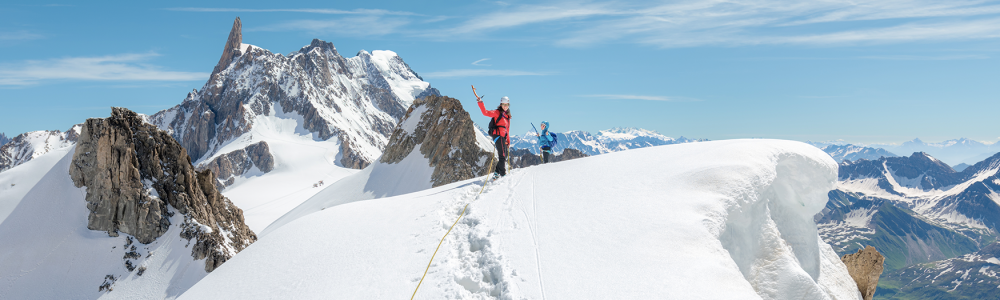
Mont Blanc is an iconic peak, accessible to most people yet challenging enough to be a real human endeavour. Its 4,810 metres also form an altitude barrier that requires acclimatisation. This is therefore a climb that involves a significant level of commitment and requires great motivation. Our role is to open the doors to the summit for you by adapting to your abilities and the conditions on the mountain.
Mont Blanc rises in the heart of the Mont Blanc massif and is the highest point in the Alps. It is also the highest peak in Western Europe, earning it the nickname ‘Roof of Europe’. It straddles France and Italy, south of Chamonix (Haute Savoie, 200km east of Lyon) and north-west of Courmayeur. It dominates the famous Aiguille du Midi to the north and the Grandes Jorasses to the north-east, and feeds the Bossons glacier towards the Arve valley.
Mont Blanc is the highest peak in Western Europe. However, if we consider that Europe extends to the Caucasus (in accordance with the geopolitical vision of the Council of Europe), then four peaks exceed it on Russian and Georgian territory: Elbrus, which rises to 5,642 metres, Dykh Tau at 5,203 metres, Shkhara at 5,058 metres and Kazbek at 5,047 metres. The altitude given is always that of the thick layer of snow covering the summit. The rocky summit rises to 4,792 m and is offset by 40 m to the west of the peak, according to radar core sampling instruments.
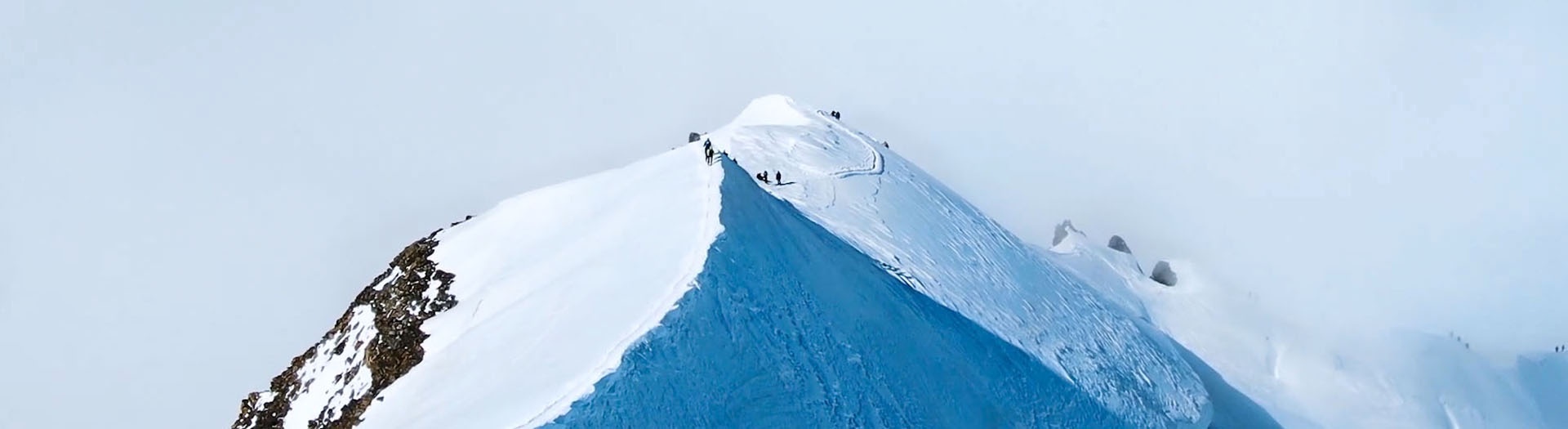
The climb requires specific mountaineering techniques that should not be overlooked: three months of preparation before departure, use of crampons and ice axes, rope progression, and acclimatisation to altitude. However, it is worth remembering that 20,000 to 30,000 people successfully climb the mountain each year. Nowadays, Mont Blanc welcomes hundreds of mountaineers every year and is mistakenly considered a long but easy climb, provided you are well trained and accustomed to altitude. This impression is reinforced by the fact that when you are at the Aiguille du Midi in good weather, Mont Blanc can look like a gentle ‘snow-covered hill’ 1,000 metres higher up. But this impression is misleading. It is a climb that requires a minimum of high mountain knowledge and should not be attempted without a guide or adequate equipment. It is a really long climb with tricky passages such as the Couloir du Goûter with rock falls. In addition, a night in the refuge is a minimum requirement to acclimatise to the altitude and reduce the risk of acute mountain sickness.

 Alpinism