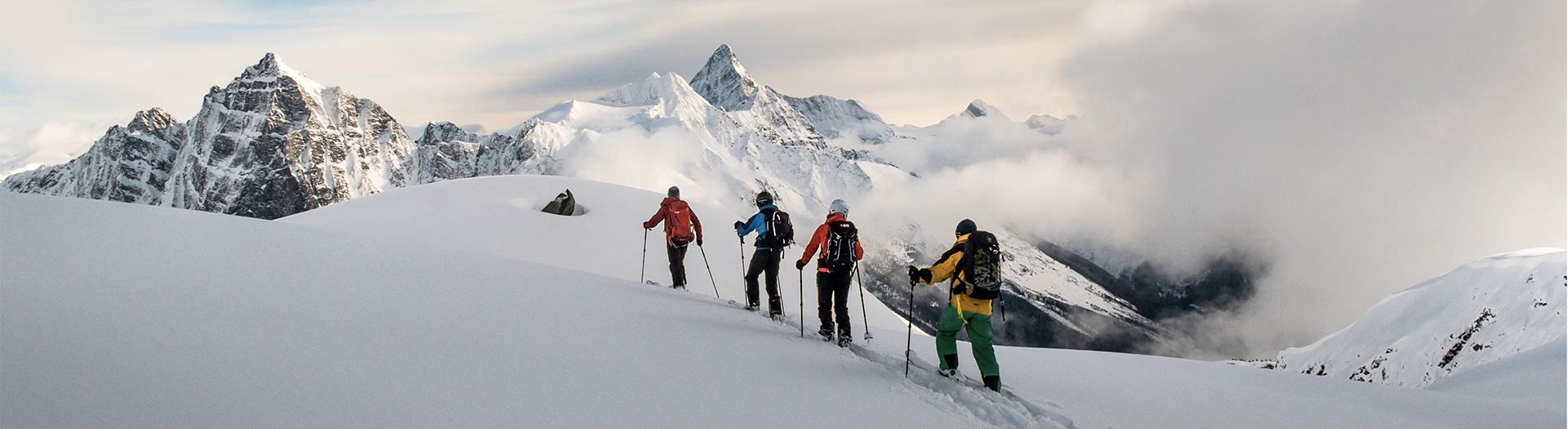

Ski touring at 4000m in Gran Paradiso
It is the only 4,000-meter peak entirely within Italy: the famous Gran Paradiso is known as a true paradise for ski tourers.
Itinerary
-
Day 1 Pont (Italy) - Victor Emmanuel Refuge (2,730 m)
 Meet in Chamonix, presentation of the program and check of bags and personal equipment. Transfer by personal vehicles to the village of Pont in Italy in the Valsavarenche valley. Then climb to the Victor Emmanuel Refuge (2,730 m). After leaving your belongings at the refuge, you will do some mountain safety exercises and possibly a first descent to warm up your legs so that you are ready for the next day's climb.
Elevation gain: Approximately 800m | Maximum altitude: 2730m | Accommodation: Overnight stay at the Victor Emmanuel refuge.
-
Day 2 Ascent of Gran Paradiso (4,061 m).
 The climb is via a series of valleys that lead to the large glacier, which we ascend until we reach a final slope. The last few meters are rocky, requiring a few steps of climbing where you need to be sure-footed, and then we reach the summit, a beautiful rocky platform where a statue of the Virgin Mary stands, contemplating the landscape. It is one of the most beautiful viewpoints in the Alps, with views of Mount Viso and Monte Rosa. A spectacular descent to the Victor Emmanuel refuge.
Elevation gain: Approximately 1350m | Elevation loss: Approximately 1350m | Maximum altitude: 4061m | Accommodation: Night at the Victor Emmanuel refuge.
-
Day 3 Ascent of Tresenta (3,609 m)
 Ascent of the beautiful summit of Tresenta, then descent via the summer path through the woods along a trail, returning to Pont in the afternoon. Return transfer with personal vehicles to Chamonix.
Elevation gain: Approximately 900m | Elevation loss: Approximately 1650m | Maximum altitude: 3609m
Important :
Dates & prices
Departures for French-speaking groups:
| From | To | Price per person | Guaranteed | Booking |
|---|---|---|---|---|
| €715 | No | Book now! | ||
| €715 | No | Book now! | ||
| €715 | No | Book now! |
International departures:
No departure for now
Trip code: SRGP3
Included
A 30% deposit is payable at the time of registration, with the balance due 30 days prior to departure.
- Technical organization of the trip
- Supervision by a high-mountain guide
- Provision of shared equipment
- Half-board accommodation in mountain huts
- Lunch picnics
- Safety equipment: avalanche transceiver (batteries not provided), shovel, and probe
Not included
- Personal equipment: harness, crampons, ice axe, helmet
- Ski touring equipment: boots, skis, skins, crampons, poles
- Batteries for avalanche transceiver (4 LR03 AAA batteries)
- Drinks and personal expenses
- Food for the trip (cereal bars, dried fruit, chocolate bars, etc.) as you see fit.
- Transport to the meeting point and from the dispersal point
- Insurance/assistance: mandatory search and rescue by helicopter, hospitalization, and repatriation costs
Terms and conditions
Booking conditions
Invoice procedure
Cancellation policy
Cancellation on your behalf:
Cancellation on our behalf:
Changes to travel contract
Pricing
Contract transfer
Insurance
Practical info
Staff
Our trip is supervised by a high-mountain guide who will provide you with the technical information you need to ensure your trip runs smoothly. The guide may modify the program to ensure safety depending on weather conditions in the mountains or the condition of participants.
Food
Meals:
Picnics for lunch.
Dinner in the refuges.
Remember to bring food according to your tastes before departure.
Drinks:
Personal drinks are not included in the trip.
Please note: bottles of water in refuges are expensive, costing €5 to €8 on average.
Bring water purification tablets such as Micropur if you do not want to buy bottled water (where possible).
It is customary in the mountains for clients to pay for the guides' drinks: the best solution is to set up a group fund at the start of the trip, based on each person's means.
Accommodation
All the shelters along the route are comfortable and welcoming. The dormitories sleep 8 to 10 people and are equipped with blankets or duvets for the night (bring a sleeping bag liner for hygiene reasons). Slippers or Crocs are available in the shelters, so there is no need to bring sneakers. Bring earplugs or similar to protect against noise. There are no showers as there is no running water in the refuges except for water from the glaciers. There are a few electrical outlets available in the refuges, but it is best to bring a spare battery for your camera and turn off your phone during the day.
Supplied equipment
• Shared equipment (ropes) is provided.
• Slippers are available at the refuge.
• Blankets and duvets are provided at the refuge: please bring a sleeping bag liner for hygiene reasons.
• Personal safety equipment (avalanche transceiver batteries not provided, shovel, probe): please notify the agency if you have your own.
Vital equipment
Skis
• 1 pair of lightweight touring skis with suitable bindings and brakes or safety straps, waxed.
• 1 pair of touring ski boots with VIBRAM soles.
• 1 pair of self-adhesive climbing skins suitable for the skis.
• Crampons suitable for the bindings.
• Poles with large baskets.
Other
• Safety equipment: avalanche transceiver, shovel, probe
• Crampons with “Antibott” system
• Ice axe
• Harness and screw-lock carabiners
• Survival blanket
• 1 headlamp with batteries and spare bulb
• Pocket knife
• Thermos and water bottle
Material
• Beanie
• Hat or cap
• Scarf and/or neck warmer
• Sunscreen (very high protection factor) and lip balm
• Ski goggles/glacier sunglasses category 4+
• 2 pairs of breathable long-sleeved technical underwear such as “Carline” (no cotton, which dries too slowly)
• 1 technical, breathable base layer
• 1 thick fleece jacket
• 1 down jacket or vest
• 1 windproof and waterproof jacket, such as Goretex
• 1 pair of mittens (fleece or wool)
• 1 pair of gloves (fleece or wool)
• 1 pair of undergloves
• 1 pair of breathable technical tights, such as Carline
• 1 pair of comfortable mountain pants
• 1 pair of windproof and waterproof pants, such as Goretex
• 2 pairs of socks: 1 thin and 1 thick
Other:
• 1 sleeping bag liner for shelters
• 1 small toiletries bag with 1 quick-dry towel
• Biafine
• Toilet paper + lighter
• 1 or 2 100L plastic bags and an oversack to protect your belongings and backpack
• 1 waterproof pouch in which to put your ID, phone, money, and insurance/assistance contract with all emergency phone numbers
Luggage
In the mountains, you will carry all your belongings, picnics, and equipment in a 40/50-liter mountaineering backpack.
Medicine
Your guide will have a first aid kit.
Discuss your personal first aid kit with your doctor:
• personal medication
• painkillers (preferably paracetamol)
• double-skin
• elastic bandages
• bandages
• local disinfectant
• anti-inflammatory medication
• antispasmodic medication
• anti-diarrhea medication
• anti-vomiting medication
• intestinal antiseptic
• eye drops
• mild sleeping pills
• earplugs
This list is not exhaustive.
Weather
Electricity
Electricity will be available in most of the places where you will be staying. If you are concerned about your device's battery life, we recommend bringing a portable power bank.
French power outlets are unique as they feature two pins and a male earthing pin (Type E). If you require an adapter, please ensure you purchase one before your departure. In France, the standard voltage is 230V and the frequency is 50Hz.
Local time
Standard Time (CET: Central European Time): UTC +1
Daylight Saving Time (CEST: Central European Summer Time): UTC +2
Sustainable tourism
We strive to offer experiences that uphold the principles of sustainable and responsible tourism. Our goal is to help you discover the many facets of a country by taking you off the beaten path, connecting you with nature and its inhabitants, while ensuring your visit has no negative impact on the natural environment.
- Local Impact: Most of our accommodations are locally managed. This ensures that the majority of the revenue generated during your stay remains within the region and supports the local community.
- Cuisine: The art of cooking and the joy of sharing a meal are central to our daily lives. Each region has its own specialties, and we are sure you will delight in discovering them!
- Water Conservation: Water is a precious and scarce resource. Our team and fellow travelers are strongly encouraged to use it mindfully and avoid excessive consumption whenever possible.
- Waste Management: We kindly ask you to recycle your waste whenever possible, keeping in mind that recycling practices may vary across different parts of the world.
- Respectful Hiking: Please be mindful and respectful while trekking. Ensure you wear footwear appropriate for your activity and take care to leave no trace: avoid picking wildflowers, displacing rocks, or lighting fires.
My local agent
Emilien
- Après des expériences variées dans l'événementiel sportif sur les différents massifs grenoblois, je suis ravi d’évoluer dans ce nouveau milieu au cœur du massif du Mont-Blanc, je suis un grand passionné de montagne et de nature, notamment à travers la pratique sportive, que ce soit en trail, escalade ou alpinisme.
- Region
- Italy
- Activity
- Mountain huts experience Ski touring
- Duration
- 3 days
- Group
- 4 to 4 people
- Code
- SRGP3
- Price
- From €690
- Level
- 4/5
- Comfort
- 3/5
- Language(s)
- French / English
Strengths
- Climbing a 4,000m peak.
- Discovering the Gran Paradiso National Park.
- Small groups of 3 to 4 people.
Guide's advice
With its approachable slopes and excellent exposure, Gran Paradiso is the perfect summit for your first 4,000m ski touring ascent. The stunning landscapes and high-quality snow will satisfy even the most seasoned experts!