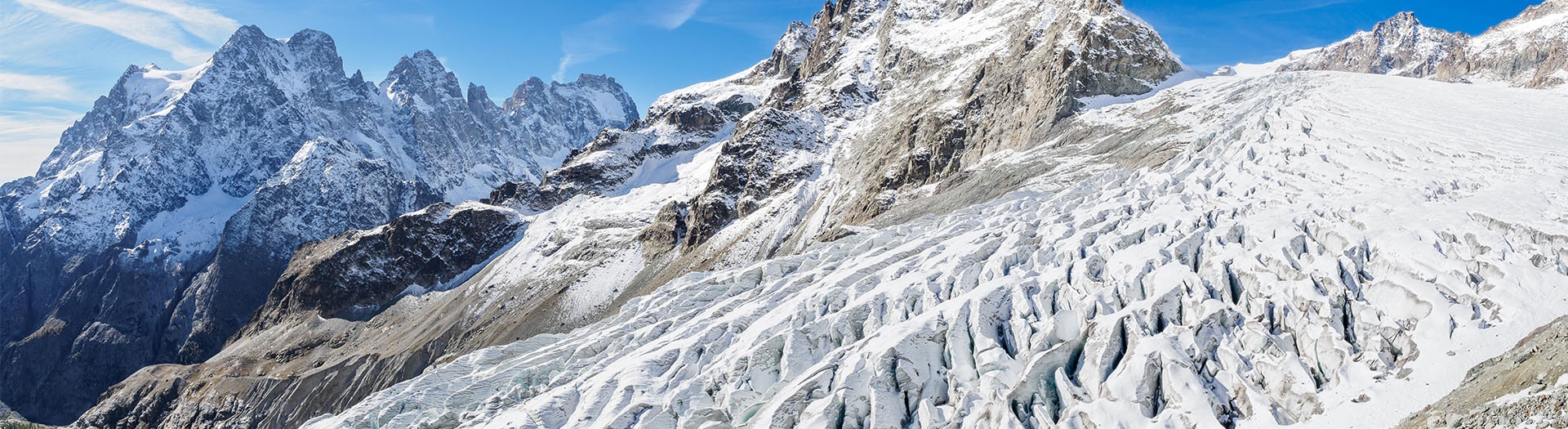

Discover mountaineering in the Ecrins
This three-day course in the heart of the Ecrins massif, around the Glacier Blanc, will teach you the basics of mountaineering and high-altitude climbing.
Itinerary
-
Day 1 Discover mountaineering equipment and techniques on the glacier
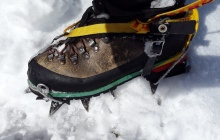 Meet at L'Argentière-La-Bessée train station in the morning, then drive your own vehicle to the starting point of the adventure, which will begin with a hike to the Glacier Blanc refuge. The afternoon will allow you to familiarize yourself with mountaineering and glacier walking techniques. How to attach crampons, rope up, what is an ice screw used for? An ice axe? You will learn all this and more throughout the afternoon with fun exercises to discover the basics of mountaineering.
Dinner and overnight stay in a dormitory at the mountain refuge at 2,542m.Distance: 5 km | Elevation gain: approx. 650 m | Maximum altitude: 2,542 m | Accommodation: Refuge du Glacier Blanc
-
Day 2 Glacier Blanc and first summit
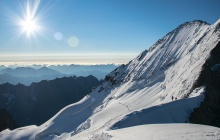 Departure before dawn to one of the peaks overlooking the refuge and the Glacier Blanc: the Pic du Glacier d'Arsine (3,364 m).
You will climb in a rope team and put into practice the mountaineering techniques you learned the day before.
Descending from the summit, you will reach the Refuge des Écrins (3,170 m).
Meal, overnight stay, and breakfast at the Refuge des Écrins.Distance: 6 km | Elevation gain: approx. 950 m | Elevation loss: approx. 350 m | Maximum altitude: 3,364 m | Accommodation: Refuge des Ecrins
-
Day 3 Summit of Roche Faurio (3,730 m)
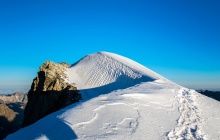 Another early start on this final day, as we set off at dawn to climb Roche Faurio, 3,730 meters. We enjoy the majestic views from the Ecrins viewpoint before beginning our descent, leaving behind the timeless world of the high mountains and returning to the valley.
Distance: 14 km | Elevation gain: approx. 550 m | Elevation loss: approx. 1,810 m | Maximum altitude: 3,730 m | Accommodation: Refuge des Ecrins
PROGRAM CHANGES
Dates & prices
Departures for French-speaking groups:
No departure for now
International departures:
No departure for now
Trip code: AECR
Included
- Technical organization of the trip
- Supervision by a high-mountain guide.
- Full board accommodation from lunch on day 1 to afternoon on day 3.
- All necessary safety equipment.
Not included
- Individual technical equipment.
- Drinks in shelters and personal expenses.
- Individual food supplies.
- Travel to the starting point of the hike.
Notes
- Drinks in shelters and personal expenses.
- Water in shelters (allow €7 to €10 per bottle).
- Rental of boots, harness, helmet, crampons, and ice axe if necessary.
Terms and conditions
Booking conditions
Invoice procedure
Cancellation policy
Cancellation on your behalf:
Cancellation on our behalf:
Changes to travel contract
Pricing
Contract transfer
Insurance
Practical info
Staff
Our course is supervised by a mountain guide who will provide you with the technical skills you need to make the most of the week.
Food
Meals
• Picnics for lunch,
• Evening meals prepared by the refuge wardens.
• Bring food for the hike according to your personal tastes before departure: cereal bars, chocolate bars, dried fruit, etc.
Drinks
• Water is sold in the refuges. Expect to pay €5 to €8 per bottle, depending on the hut. We therefore recommend that you bring water purification tablets (such as Aquatabs) so that you can drink tap water and water from streams.
• Personal drinks (coffee, beer, soda, etc.) are not included in the trip: remember to bring Swiss francs for the huts.
Accommodation
Nights at the refuge are spent in dormitories. Blankets are provided, but remember to bring a sleeping bag liner. Toiletries should be kept to a minimum. Slippers are available, so there is no need to bring shoes for the refuge.
Transportation
A backpack with a capacity of 40 to 50 liters with a waist belt and comfortable shoulder straps.
Tips
Travelers usually pay for the guide's drinks: you may find it convenient to set up a kitty at the beginning of the trip (no obligation).
Supplied equipment
• Shared equipment (ropes, carabiners) is provided.
Vital equipment
• High-altitude hiking boots
• An ice axe, crampons with anti-balling plates, a harness equipped with two screw-lock carabiners (available for hire)
• 1 helmet
• Quickdraws, descender (if you have one)
• A pair of gaiters
• A sleeping bag liner (blankets are provided in the refuge)
• A small toiletries bag
• Sunscreen (face and lips)
• A headlamp with spare batteries
• A pocket knife
• A water bottle
• Toilet paper + lighter
• Two to three plastic bags (100 liters) to protect your backpack in case of rain.
Helpful equipment
- Beanie
- Sun hat (or cap) and/or scarf
- Glacier sunglasses
- 1 pair of fleece or wool gloves
- 1 pair of gloves
- Breathable technical underwear
- Breathable technical base layer (carline, light fleece, etc.)
- Fleece jacket
- 1 windproof and waterproof jacket (Gore-Tex type)
- 1 pair of comfortable mountain pants
- 1 pair of windproof pants (Gore-Tex type)
- 2 pairs of socks, one thin pair and one thicker pair.
- Telescopic poles (recommended)
- Thermos or water bottle (minimum 1 L)
- Minimum toiletries (no showers in the refuge)
- Small first aid kit adapted to your needs (blister plasters, personal medication, etc.)
Medicine
Your guide will carry a collective first aid kit, but it is important to bring a small personal first aid kit.
Individual first aid kit to be prepared with your doctor:
• Painkillers (avoid aspirin).
• Anti-inflammatories (tablets and gel).
• Bandages and blister plasters in case of blisters.
• Elastoplast (excellent for preventing blisters on the heels).
• Sunscreen and Biafine.
• Water purification tablets (such as Aquatabs).
Bottled water is very expensive in mountain huts.
• If necessary, a mild sleeping pill and/or earplugs for the night.
• Your personal medication...
• Antispasmodic
• Anti-diarrhea medication
• Anti-emetic medication
• Intestinal antiseptic
• Eye drops
This list is not exhaustive.
Passport
Visa
No visa required
Mandatory vaccines
No mandatory vaccination
Health information & recommendations
Before your departure, it is important to be in good physical condition, in line with the expectations of the program and the activity. Daily physical activity and regular endurance sports training are essential for high-altitude mountain activities. Please inform the agency of any medical information and particularities concerning your health: food allergies, diabetes, cardiovascular accidents you may have had, asthma, etc.
It is important to consult your doctor well in advance of your departure. We recommend that you carry a first aid kit and any personal medical supplies you may need. Please bear in mind that we are often in remote locations, far from medical facilities. Please read the brochure and itinerary for your chosen trip carefully to ensure that it is suitable for you.
Please note that you will be traveling at high altitude. Most individuals can travel at 2,500 meters with minimal effects. However, everyone reacts differently to altitude and altitude sickness can occur. For more details on how to prepare for your trip, please consult your doctor.
Weather
Unpredictable weather is part of the charm of any mountaineering course. In this mountain range, the weather can change very suddenly, the wind can blow very strongly, and snow can fall heavily at medium altitudes, even in the middle of summer. We are therefore very vigilant in anticipating weather changes and, if necessary, we adapt our programs according to the conditions ahead.
Electricity
Most of the places where you will be staying will have electricity. If you are worried about running out of battery power, we recommend bringing an external battery. Plugs in France are unique in that they are both male and female: they have two prongs and a receptacle. If you need an adapter, please purchase one before you leave.
Local time
Standard time (CET: Central European Time): UTC +1
Summer time (CEST: Central European Summer Time): UTC+2
Sustainable tourism
We do our best to offer trips that respect the principles of sustainable and responsible tourism. Our goal is to allow our visitors to discover the different facets of a country by taking you off the beaten track and putting you in touch with nature and its residents, while ensuring that your visit has no negative impact on the natural environment. Most of our accommodations are managed by locals. Most of the income generated during your stay will therefore remain in the region. The art of cooking and the joy of tasting food are part of our daily life. Each region has its own specialties, and you are sure to enjoy them! Water is a precious and rare commodity. Our team and those traveling with us are therefore strongly advised to use it wisely and avoid excessive water consumption whenever possible. Please try to recycle your waste whenever possible, even though recycling may not be a concept practiced everywhere in the world. Be mindful and respectful when hiking. Be sure to wear shoes that are suitable for your activity and avoid picking flowers, moving rocks, or lighting fires.
My local agent
Emilien
- Après des expériences variées dans l'événementiel sportif sur les différents massifs grenoblois, je suis ravi d’évoluer dans ce nouveau milieu au cœur du massif du Mont-Blanc, je suis un grand passionné de montagne et de nature, notamment à travers la pratique sportive, que ce soit en trail, escalade ou alpinisme.
- Region
- France
- Activity
- Alpine summits Alpinism Discovering mountaineering
- Duration
- 3 days
- Group
- 4 to 5 people
- Code
- AECR
- Price
- From €670
- Language(s)
- French / English
Strengths
• A true introduction to mountaineering
• A mountain atmosphere in two ideally located refuges
• 3 days of learning basic mountaineering techniques
Guide's advice
This high-altitude training course is a great way to discover mountaineering in the “welcoming” mountains of the Ecrins massif.